

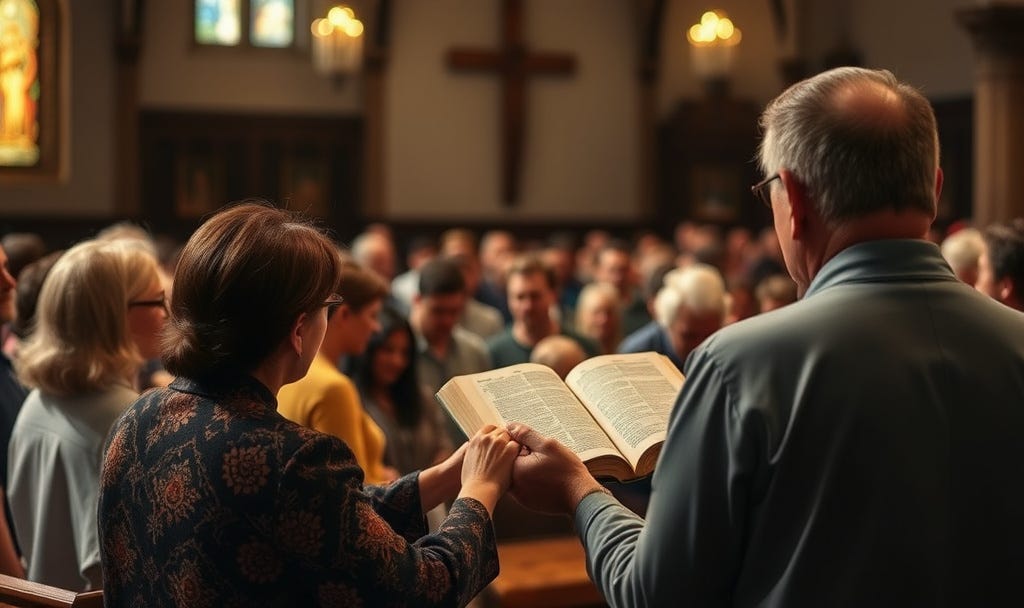
We have added a great deal to our worship services in the last generation. We have added projection screens and stage lighting, worship bands and carefully curated transitions, coffee in the lobby, countdown clocks in the sanctuary, livestreams, and production teams. None of these things are wrong by default and in themselves. Technology can serve the church. Music is a biblical gift. Hospitality matters. Excellence can be an expression of love for God and neighbor.
But every addition asks a question: What have we quietly removed to make room for it?
In many churches, the answer is the sustained, public reading of Scripture.
A verse appears on a screen behind the preacher, sometimes one sentence, sometimes half a sentence, lifted from its paragraph and quickly followed by commentary. The congregation sees it for a few seconds, the preacher moves on, and everyone assumes they have “read the Bible together.”
But a verse on a slide is often not public Scripture reading. It is a caption.
It may support a sermon point. It may decorate a transition. It may give biblical language to an otherwise useful message. But the church has not truly sat under the Word when it has only glanced at fragments of it.
The public reading of Scripture is not a preliminary formality before the “real” worship begins. It is worship. It is not filler before the sermon, nor a brief devotional thought before the music. It is the living God addressing his gathered people through the Word he has given.
The church does not merely gather to speak to God. It gathers to hear from him.
A People Formed by a Spoken Word
From the beginning, God’s people have been formed by hearing his Word spoken aloud.
In Genesis, God creates by speaking: “And God said, ‘Let there be light,’ and there was light” (Genesis 1:3). God’s Word is not empty sound. It accomplishes what he intends.
Isaiah says:
“For as the rain and the snow come down from heaven
and do not return there but water the earth,
making it bring forth and sprout…
so shall my word be that goes out from my mouth;
it shall not return to me empty,
but it shall accomplish that which I purpose.”
—Isaiah 55:10–11
God’s Word creates, reveals, convicts, comforts, corrects, gives life, and calls his people back to himself. It is not merely information to master. It is divine speech to receive.
This is why Israel was commanded not only to preserve the Scriptures but to hear them.
In Deuteronomy, Moses instructed Israel to gather men, women, children, and even resident foreigners “that they may hear and learn to fear the Lord your God, and be careful to do all the words of this law” (Deuteronomy 31:12). Notice who is included: everyone. The gathered people were to hear the Word together because covenant life was not sustained by private spirituality alone. The Word formed them as a people.
The book of Joshua records that after entering the land, Joshua read “all the words of the law, the blessing and the curse,” before the entire assembly of Israel, “with the women, and the little ones, and the sojourners who lived among them” (Joshua 8:34–35).
No one was excluded because they were not a leader, scholar, or public speaker. The Word belonged to the whole people of God.
Ezra and the People Who Stood to Listen
One of the clearest pictures of public Scripture reading appears in Nehemiah 8.
Israel had returned from exile. Jerusalem was damaged, its walls broken, and its people vulnerable. They needed rebuilding, but their deepest need was not first architectural, political, or economic. They needed to be re-formed by the Word of God.
So the people asked Ezra the scribe to bring “the Book of the Law of Moses” (Nehemiah 8:1). Ezra stood on a wooden platform and read from early morning until midday. The text tells us, “The ears of all the people were attentive to the Book of the Law” (Nehemiah 8:3).
Imagine the scene. Men and women, children old enough to understand, leaders and laborers, the secure and the wounded, all gathered around the same Word. No one was entertained into renewal. No elaborate experience was required to make God’s speech meaningful. Ezra opened the Book, and “all the people stood” (Nehemiah 8:5).
Then the Levites helped the people understand what was read: “They read from the book, from the Law of God, clearly, and they gave the sense, so that the people understood the reading” (Nehemiah 8:8).
This is a helpful pattern for the church: read the Word clearly, then help people understand it. Explanation matters. Teaching matters. Preaching matters. But explanation follows the reading; it does not replace it.
The reading came first. God spoke. Then the people responded.
Their response was not shallow enthusiasm. They worshiped, bowed down, wept, confessed, rejoiced, and obeyed. The Word exposed their sin, reminded them of God’s faithfulness, and restored their identity as God’s covenant people.
Something happened through the plain, sustained speaking of Scripture that did not require spectacle to make it powerful.
The Early Church’s Pattern
This pattern continued into the life of the early church.
The first Christians inherited the Scriptures of Israel, listened to the apostles’ teaching, and gathered around the good news of Jesus Christ. Acts 2:42 says, “They devoted themselves to the apostles’ teaching and the fellowship, to the breaking of bread and the prayers.”
The public reading of Scripture was central to the synagogue worship from which many early Christians came. Luke records that, in the synagogue at Pisidian Antioch, “after the reading from the Law and the Prophets,” the leaders invited Paul and Barnabas to speak (Acts 13:15). Reading came before exhortation.
Jesus himself followed this pattern. In the synagogue at Nazareth, he was handed the scroll of Isaiah. He found the passage, read it aloud, and then sat down to explain its fulfillment: “Today this Scripture has been fulfilled in your hearing” (Luke 4:16–21).
Jesus read the text. Then he preached the text.
Paul gave the same instruction to Timothy, a young pastor charged with leading the church at Ephesus: “Until I come, devote yourself to the public reading of Scripture, to exhortation, to teaching” (1 Timothy 4:13).
The command is direct. Timothy was not merely told to read Scripture occasionally, or to use it as a source of sermon illustrations. He was told to devote himself to its public reading.
The order is important:
Public reading of Scripture.
Exhortation.
Teaching.
Before the minister explains God’s Word, God’s Word is read. Before the preacher speaks to the congregation, the congregation hears the voice that carries final authority.
This also protects the church. Every preacher, however gifted, is fallible. Every sermon carries the limits, assumptions, emphases, and blind spots of the one delivering it. But Scripture remains the church’s final rule of faith and life. When the Word is read publicly, the people do not merely receive one person’s reflections about God. They hear the Word God has given.
Paul understood the importance of this so deeply that he commanded that his letters be read aloud in the churches. “I put you under oath before the Lord to have this letter read to all the brothers” (1 Thessalonians 5:27). He also instructed the Colossians, “When this letter has been read among you, have it also read in the church of the Laodiceans” (Colossians 4:16).
The letters we now call the New Testament were first received as letters to be heard in gathered worship.
Scripture Is Not a Caption
There is a difference between using the Bible and being shaped by the Bible.
A preacher can quote many verses and still leave the congregation with only scattered fragments. A church can have Bible verses on screens, banners, social media posts, and sermon notes, while seldom allowing a full passage to speak in its own context.
This matters because context carries meaning.
Consider how easily a familiar line can be misunderstood when detached from its setting. “I can do all things through him who strengthens me” (Philippians 4:13) is often used as a slogan for personal achievement. But Paul is speaking about learning contentment in abundance and in need. The promise is not that Christ guarantees every ambition; it is that Christ sustains his people in every circumstance.
Or consider Jeremiah 29:11: “For I know the plans I have for you, declares the Lord.” It is often presented as an immediate promise of individual success. But it was spoken to a people in exile, many of whom would not live to see the return. Its message is not quick prosperity but God’s long-term faithfulness to his covenant people.
A verse can be true while being used poorly. Public reading of larger portions helps protect the church from this. It allows Scripture to speak with its own grammar, argument, story, tone, and emphasis.
When we hear a whole Psalm, a complete Gospel episode, a section of Paul’s letter, or an extended prophetic passage, we encounter more than a collection of spiritual sayings. We encounter God’s unfolding story.
We hear lament and praise, warning and promise, command and comfort, doctrine and narrative, judgment and mercy. We hear the parts of Scripture we might not choose for ourselves: genealogies, difficult teachings, cries of sorrow, calls to repentance, and promises that require patience.
The Bible is not a box of inspirational quotations. It is the story of God’s creation, humanity’s fall, Israel’s calling, Christ’s saving work, the church’s mission, and the coming renewal of all things.
A caption cannot carry that weight.
The Word Is Living and Active
Why do many churches rush past public reading? Perhaps because we have quietly lost confidence in what the words are.
If Scripture is merely religious information, then it makes sense to get through it quickly so that we can arrive at the parts we consider more engaging: the music, the message, the stories, the illustrations, the practical advice, or the emotional moment.
But Scripture speaks of itself differently.
“The word of God is living and active, sharper than any two-edged sword,” says Hebrews 4:12. It pierces beneath appearances. It discerns “the thoughts and intentions of the heart.” The Word does not merely inform us; it examines us.
James compares the Word to a mirror: “For if anyone is a hearer of the word and not a doer, he is like a man who looks intently at his natural face in a mirror” (James 1:23). Scripture shows us what we are really like. It exposes our self-deception, names our sin, and calls us into obedience.
Paul says that “all Scripture is breathed out by God and profitable” for teaching, correction, rebuke, and training in righteousness (2 Timothy 3:16–17). Scripture does not merely inspire; it equips. It forms believers “for every good work.”
The Word of God is not powerful because the reader has a polished voice, because the musicians create the right atmosphere, or because the preacher gives an impressive introduction. God’s Word is powerful because God speaks through it.
A sword does not need decoration in order to cut. It needs to be unsheathed.
That does not mean readers should be careless, unprepared, or dull. Scripture should be read audibly, thoughtfully, reverently, and with understanding. But the power is not in our performance. The power is in the Word itself and in the Spirit who uses it.
The task is simple: open the Book, read it clearly, and trust God to work.
The Word Belongs to the Whole Church
There is a quiet democracy in public Scripture reading that our performance culture can easily erase.
When a passage is read aloud in the gathered church, it is given to everyone in the room at the same moment. The single mother in the back row and the elder in the front receive the same promise. The teenager who has never opened a Bible and the seminary professor hear the same story. The grieving widow, the new believer, the child, the struggling doubter, the wealthy donor, and the person sleeping in a shelter all stand under the same authority.
No one needs to be clever enough to find the passage alone. No one needs to own a study Bible, understand theological vocabulary, or have years of Christian background in order to hear God’s Word.
This is especially important for the church because Christianity has always been a faith of hearing. For much of history, many believers could not read. Even today, literacy levels, language barriers, disabilities, and access to resources shape people’s ability to engage Scripture privately.
Paul writes, “Faith comes from hearing, and hearing through the word of Christ” (Romans 10:17). Public reading ensures that the church’s life is not built only around the private habits of the educated, the digitally connected, or the spiritually confident. The Word comes to the whole body.
Revelation begins with a promise that assumes public worship: “Blessed is the one who reads aloud the words of this prophecy, and blessed are those who hear” (Revelation 1:3).
There is a blessing for the reader and for the hearers.
Scripture is not simply content to be consumed alone. It is a covenant word to be received together.
The Church Is Not an Audience
Much of modern church culture has been shaped, often without intending it, by the logic of entertainment.
A stage is built. A program is designed. Specialists perform. The congregation watches, receives, reacts, and evaluates. Did the music move me? Was the sermon practical? Did the service hold my attention? Did the experience meet my expectations?
These questions are understandable, but they can reveal that we have begun to imagine worship as a product and the congregation as its consumers.
The gathered church is not an audience assembled around a stage. It is a people assembled around the risen Christ.
And Christ addresses his people through Scripture.
This is why the public reading of God’s Word is so spiritually important. It changes the posture of the room. We are not there primarily to be impressed. We are there to listen, repent, believe, rejoice, pray, sing, receive grace, and be sent out in obedience.
The Word is not one element competing for attention among many. It is the voice that gathers, corrects, comforts, and commissions the church.
When Scripture is read, God’s people are reminded that they do not belong to the preferences of a pastor, the trends of a denomination, the mood of a culture, or the demands of an algorithm. They belong to the God who has spoken.
What Long Reading Gives Us
Short passages have their place. A brief call to worship can focus a congregation. A single verse can be memorized, prayed, or sung. But a church that hears only brief passages will often become a church shaped by the texts it prefers.
Longer readings teach us to receive Scripture rather than merely select it.
They require us to hear things we might have skipped: God’s judgments, the cries of the oppressed, hard commands, long waiting, unresolved questions, and the patient unfolding of God’s promises. They also allow us to hear the beauty of biblical writing: the movement of a Psalm, the logic of an epistle, the tension of a Gospel narrative, and the sweeping vision of a prophetic oracle.
For example, hearing all of Psalm 13 allows a congregation to feel the journey from “How long, O Lord?” to “But I have trusted in your steadfast love.” Hearing only the final verse may offer encouragement, but it skips the honesty of lament that makes the confidence meaningful.
Hearing Luke 15 as a whole lets us see the lost sheep, the lost coin, and the lost sons together. The father’s welcome of the younger son becomes even more striking when we recognize the older brother’s resentment and the father’s appeal to him as well.
Hearing Romans 8 in its fullness brings together no condemnation, life in the Spirit, adoption, suffering, hope, prayer, God’s sovereign love, and the assurance that nothing can separate us from Christ. No isolated verse can carry the entire force of that chapter.
The church needs the whole counsel of God, not merely its favorite lines.
Recovering the Practice
Recovering public Scripture reading does not require a larger budget, more advanced technology, or a more impressive production. In fact, its simplicity may be one reason we neglect it. It does not feel innovative. It does not promise a dramatic emotional response. It cannot be reduced to a branding strategy.
But it can be done.
Churches can begin by reading longer portions of Scripture in every gathering. This might be a Psalm, a complete Old Testament reading, a Gospel passage, or a substantial section from an epistle. The goal is not to make services longer for their own sake. The goal is to make room for God’s Word to be heard in context.
Churches can use a lectionary or a planned reading schedule so that they are not driven only by the sermon series or the pastor’s personal preferences. This helps the congregation encounter the breadth of Scripture over time.
Churches can invite ordinary members to read: young adults, older saints, parents, teachers, new believers, people from different backgrounds, and those whose voices are not usually heard from the platform. This is not a way to turn Scripture reading into a performance opportunity. It is a visible reminder that the Word belongs to the whole people of God.
Churches can train readers to read well. A reader should know the passage beforehand, understand difficult names and terms, speak slowly enough to be heard, use a clear Bible translation, and resist both monotony and theatrical exaggeration. The goal is clarity, not drama.
Churches can also resist the compulsion to explain every line immediately. Sometimes the congregation needs to hear a passage and allow it to rest in the room. A few moments of silence after Scripture reading can feel unfamiliar, but silence can be an act of faith. It says, “Something has been spoken to us that is larger than our commentary.”
A simple pattern might look like this that I have noticed growing up in some churches:
A brief invitation: “Hear the Word of the Lord.”
A sustained reading, perhaps 5 to 10 minutes.
The reader concludes: “This is the Word of the Lord.”
The congregation responds: “Thanks be to God.”
A short moment of silence.
Prayer, song, sermon, or confession shaped by what has been read.
Nothing about this is flashy. But it is deeply formative.
Let God Have the Loudest Word
None of this will necessarily trend. It may not fill a room in the way a polished set, powerful band, or gifted communicator can. It will not always feel immediately exciting. Some people will find it slow at first because our attention has been trained by speed, stimulation, and constant commentary.
But perhaps that is precisely why we need it.
A church formed by public Scripture reading learns patience. It learns to listen. It learns that not every moment must be optimized for emotional impact. It learns to trust that God is present and active when his Word is simply read.
The church has always needed gifted preaching, faithful singing, fervent prayer, the sacraments, fellowship, and hospitality. These are not rivals to Scripture reading. They are strengthened and ordered by it. The songs we sing should echo it. The sermons we preach should explain it. The prayers we pray should respond to it. The lives we live should obey it.
But before we explain the Word, sing the Word, or apply the Word, we must hear the Word.
The primary thing the church needs to dop on the Lord’s Day is not entertain itself, market itself, or impress its visitors. It is to gather to hear God.
So open the Book.
Read it plainly.
Read it slowly.
Read it in context.
Read it aloud among the people.
And let the God who spoke light into darkness have the first and loudest word in the room.
~ Sunny
All Scripture quotations are from the Holy Bible, English Standard Version (ESV).