

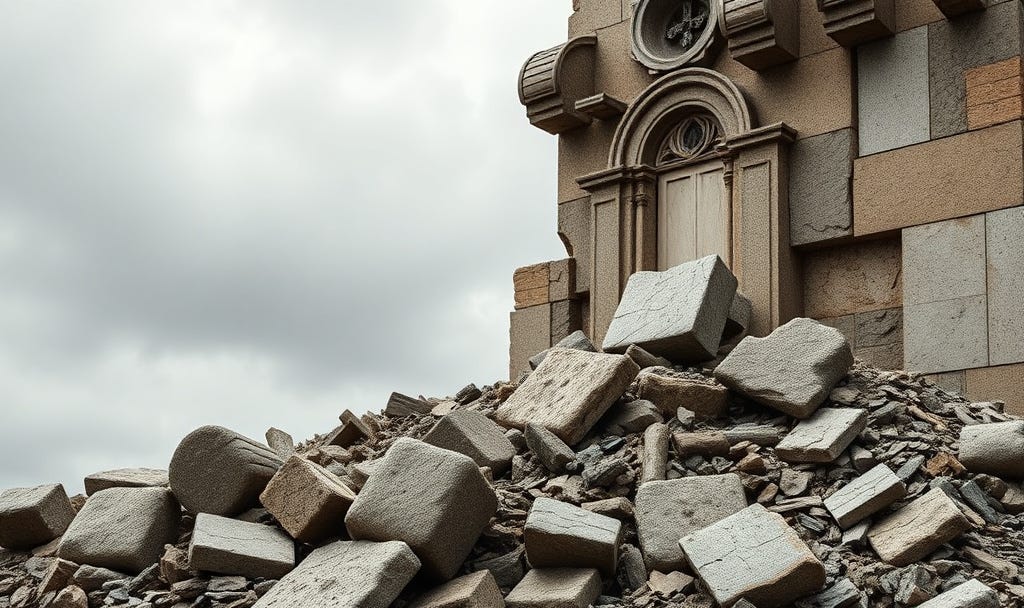
For a few years now, “deconstruction” has been the word for an often agonizing process of taking apart a faith you inherited to see whether any of it will hold. Many of us, pastors included, have watched friends and former church members walk this road. The reflexive response in much of the church has been alarm and condemnation. I want to suggest a more useful posture: listen first, because deconstruction is often telling the truth about something we would rather not hear.
Here is what it frequently gets right. It is right to refuse a faith propped up by fear, manipulation, or the suppression of honest questions. It is right to be angry when spiritual authority was used to wound rather than to heal. It is right to insist that what we were handed must be more than a tribal identity or a political program in religious clothing. Many people are not walking away from Jesus. They are walking away from a counterfeit that was handed to them in His name, and on that point they are more faithful than the systems they are leaving.
The church made much of this necessary. Where we taught certainty in place of trust, we built a faith that shatters at the first hard question. Where we demanded conformity instead of forming conviction, we raised people who could only ever rebel or comply. Where we baptized our cultural preferences and called them the gospel, we set a trap that would spring the moment someone looked closely. Deconstruction is often the bill coming due for a discipleship that was hollow all along.
But I would not be honest, or loving, if I stopped there. Because deconstruction also carries a real danger, and it is this: the tools that take a faith apart cannot, by themselves, put anything back together. Suspicion is a good servant and a terrible master. A posture that questions everything and trusts nothing does not arrive at freedom; it arrives at exhaustion. You cannot live in the permanent act of dismantling. At some point the question is not only what you are tearing down but what, if anything, you are willing to stand on.
The goal was never demolition. The goal is a faith that can bear weight: tested, honest, stripped of what was false, but still standing on something. The best of the Christian tradition has always made room for this. It is called repentance, reformation, the dark night, the refiner’s fire. The saints did not avoid the unraveling. They walked through it toward a faith that was deeper, not absent.
So to anyone in the middle of it: do not let anyone shame you for your honesty, and do not let anyone, including yourself, convince you that the only honest destination is unbelief. Take it apart if you must. But hold open the possibility that on the other side of the wreckage there is not nothing, there is a person who was never the problem, waiting with more patience than the church often showed you. Deconstruction can be a road back. Whether it is depends on what you are willing to find at the end of it.
~ Sunny