

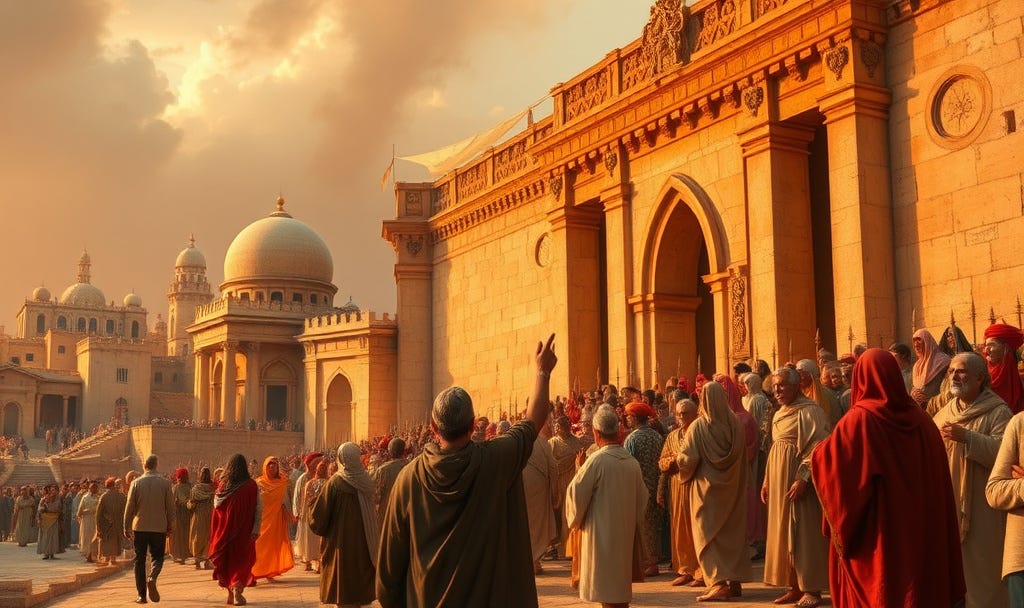
The prophets had a strange and unsettling gift. They could walk through a prosperous city and see more than its wealth, beauty, confidence, and commerce. They could see, beneath the public success, the spiritual loves organizing the people’s lives. Where others saw stability, they saw misplaced trust. Where others saw religion, they saw compromise. Where others saw national strength, they saw a people quietly being hollowed out by what they worshiped.
They named idols without flinching.
We often imagine idolatry as an ancient problem: statues of wood, metal, and stone; temples filled with incense; people bowing before images we would never take seriously. But the Bible never treats idolatry as merely an error about religious objects. At its core, idolatry is a matter of misplaced worship, trust, fear, love, and hope.
An idol is anything we treat as ultimate besides God.
It is the thing we look to for the security, identity, significance, comfort, control, or salvation only God can finally give. It may be visibly religious, but it may also be respectable, ordinary, and socially rewarded. It can be money, success, family, romantic love, political power, physical beauty, a career, a nation, a platform, approval, knowledge, health, or even ministry.
The issue is not whether these things are inherently evil. Many are good gifts from God. The issue is whether we have asked them to become gods.
A good thing becomes an idol when it becomes the thing without which we believe we cannot be whole.
The Bible’s Diagnosis of Idolatry
The first commandment is plain: “You shall have no other gods before me” (Exodus 20:3). The second forbids making images and bowing down to them (Exodus 20:4–5). But these commands are not merely about replacing one religious object with another. They are about giving one’s deepest allegiance to the living God.
Israel repeatedly struggled with this. They did not always reject God openly. Often, they tried to add other gods alongside him. They wanted the Lord for covenant protection while also turning to Baal for fertility, prosperity, rain, and agricultural abundance. They wanted spiritual security without exclusive devotion.
That temptation remains familiar. We may want God as comfort in crisis, forgiveness after failure, or a source of moral guidance—while trusting something else to make life meaningful and secure.
The prophet Ezekiel spoke of people who had “taken their idols into their hearts” (Ezekiel 14:3). That phrase matters. An idol does not need to sit on a shelf. It can live in the heart. It can quietly govern our decisions, anxieties, spending, relationships, ambitions, and imagination.
The Apostle Paul goes even further. He calls greed “idolatry” (Colossians 3:5). Why? Because greed does not merely want money; it trusts possession to provide safety, worth, and freedom. It says, “If I have enough, I will be okay.” But “enough” keeps moving.
Jesus warned, “You cannot serve God and money” (Matthew 6:24). Notice that he does not say money is always evil. He says it can become a master. It can make promises, demand loyalty, create fear, and shape a life around its pursuit.
Every idol has a promise: “Give yourself to me, and I will give you life.”
Every idol also has a demand: “Serve me, sacrifice for me, protect me, and never let me go.”
And every idol eventually disappoints, because no created thing can carry the weight of being God.
We Become Like What We Worship
Psalm 115 offers one of Scripture’s sharpest critiques of idols. It describes them as works made by human hands: they have mouths but cannot speak, eyes but cannot see, ears but cannot hear, and feet but cannot walk (Psalm 115:4–7).
Then comes the warning: “Those who make them become like them; so do all who trust in them” (Psalm 115:8).
If we worship a mute idol, we may become deaf to the voice of God and the needs of our neighbor. If we worship an image, we may begin to live for appearances. If we worship money, we may become calculating, anxious, and unable to rest. If we worship power, we may begin to treat people as obstacles, threats, or tools. If we worship approval, we may lose the ability to tell the truth.
Modern idols rarely look like statues. They are often systems, habits, devices, and ambitions that present themselves as neutral tools. But tools can become masters when they shape our desires and govern our attention.
The device that promises connection can quietly train us to fear silence. It gives us instant access to people, news, entertainment, and affirmation, but it can also fragment our attention until we struggle to be present with the people in the room.
The endless feed promises information, relevance, and engagement. Yet it can leave us anxious, angry, suspicious, and exhausted. We may know more facts than ever while becoming less wise, less patient, and less capable of sustained attention.
The market promises freedom through choice and security through accumulation. But it can teach us to view our time as inventory, our bodies as products, our neighbors as competitors, and our value as the sum of what we earn, own, achieve, or display.
The idol does not always command us to bow. Often, it simply tells us to keep checking, keep striving, keep purchasing, keep comparing, keep proving, keep consuming.
And slowly, without noticing, we obey.
Broken Cisterns and Endless Thirst
Jeremiah’s words are among the most accurate descriptions of the human condition:
“My people have committed two evils:
they have forsaken me,
the fountain of living waters,
and hewed out cisterns for themselves,
broken cisterns that can hold no water.”
—Jeremiah 2:13
A cistern was a storage pit for water. In a dry land, water was life. But God says his people have turned away from a fresh, living fountain and worked hard to dig their own containers—only to discover that those containers are cracked.
This is not merely rebellion; it is tragedy. It is choosing scarcity over abundance, stale water over a spring, exhausting labor over a gift.
The modern world is full of broken cisterns.
We keep scrolling, but remain lonely.
We keep purchasing, but remain restless.
We keep performing, but remain unsure whether we are loved.
We keep comparing, but become less grateful.
We keep chasing recognition, but fear being forgotten.
We keep trying to control every outcome, but become more anxious because life will not stay under our control.
We keep looking for a final experience, relationship, accomplishment, or possession that will settle the ache in us. But each achievement eventually becomes ordinary. Each purchase loses its shine. Each burst of praise fades. Each new source of stimulation demands another hit.
The problem is not that desire itself is bad. God made us to desire. The problem is that our desires are often pointed toward things too small to satisfy them.
C. S. Lewis observed that our desires are not necessarily too strong; often they are too weak. We settle for temporary pleasures because we have forgotten that we were made for communion with God.
Jesus speaks directly into that thirst: “Everyone who drinks of this water will be thirsty again, but whoever drinks of the water that I will give him will never be thirsty again” (John 4:13–14). He said this to a Samaritan woman who had experienced relational disappointment and social isolation. He did not shame her thirst. He revealed its true destination.
The gospel does not demand that we become people without longing. It redirects our longing toward the One who made us.
The Idols of Our Moment
Every age has particular temptations. Ancient Israel struggled with idols connected to fertility, military strength, political alliances, and agricultural prosperity. Our idols take different forms, but they often promise the same things: security, control, belonging, pleasure, significance, and escape from death.
Here are several idols that commonly shape modern life.
The Idol of Approval
This idol says, “You are worth what people think of you.”
It thrives on praise, attention, likes, invitations, credentials, and visibility. It makes criticism feel unbearable and silence feel like rejection. It can lead us to edit ourselves constantly, saying what will be rewarded rather than what is true.
The fear of man is a trap: “The fear of man lays a snare, but whoever trusts in the Lord is safe” (Proverbs 29:25). When human approval becomes ultimate, we lose freedom. We become controlled by the people whose approval we need.
The gospel gives a different foundation. In Christ, believers are already known and loved by God. Paul writes, “If God is for us, who can be against us?” (Romans 8:31). This does not make other people’s opinions irrelevant, but it puts them in their proper place.
The Idol of Success
This idol says, “You are what you achieve.”
Success may look like income, grades, prestige, influence, productivity, professional advancement, ministry results, or a carefully built reputation. Work itself is good; Scripture calls us to diligence and faithful stewardship. But work becomes idolatry when rest feels like failure, when productivity determines our worth, or when we sacrifice people, integrity, health, and worship on the altar of achievement.
Jesus asks a searching question: “What does it profit a man to gain the whole world and forfeit his soul?” (Mark 8:36).
A person can gain wealth, admiration, titles, and influence, while gradually losing the ability to love, pray, rest, receive joy, or recognize the presence of God.
The Sabbath is therefore not merely a rule about a day. It is a declaration of trust. When we rest, we confess that the world does not depend on our endless striving. God is God, and we are not.
The Idol of Control
This idol says, “I will be safe if I can manage every outcome.”
Control may appear as planning, perfectionism, anxiety, manipulation, or the relentless need to eliminate uncertainty. Wisdom and preparation are good. But the desire to control everything is not wisdom; it is a refusal to accept creaturely limits.
James warns those who plan confidently without reference to God: “You do not know what tomorrow will bring” (James 4:14). His point is not that planning is wrong, but that life is fragile and our control is partial.
The idol of control makes people exhausted because reality refuses to cooperate. It cannot prevent loss, guarantee health, secure every relationship, or protect us from death.
Faith is not passivity. It is active obedience combined with surrender. We plan wisely, work faithfully, and pray honestly, while trusting the future to the God who holds it.
The Idol of Politics and Power
This idol says, “The right leader, movement, ideology, or victory will save us.”
Political engagement matters. Christians should seek justice, love their neighbors, protect the vulnerable, and participate responsibly in public life. But politics becomes idolatry when it becomes our ultimate source of hope, identity, or righteousness.
When that happens, opponents stop being neighbors and become enemies to despise. Every disagreement feels apocalyptic. We place demands on human leaders that only the kingdom of God can fulfill.
Psalm 146 warns: “Put not your trust in princes, in a son of man, in whom there is no salvation” (Psalm 146:3). Human rulers can do real good or terrible harm, but they cannot redeem the human heart or establish God’s final kingdom.
Christians are citizens of earthly nations, but our deepest allegiance belongs to Christ. “Our citizenship is in heaven” (Philippians 3:20). That truth should make us neither disengaged nor partisan in the deepest sense. It should make us free—able to support what is good, resist what is evil, and refuse to give any earthly power the worship it wants.
The Idol of Comfort
This idol says, “The highest good is avoiding pain.”
Comfort is a gift. Rest, pleasure, safety, beauty, food, laughter, and recreation can all be received with gratitude. But comfort becomes an idol when we refuse every costly act of love, every difficult truth, every inconvenient neighbor, and every call to obedience that disrupts our ease.
Jesus did not promise a life without hardship. He said, “If anyone would come after me, let him deny himself and take up his cross daily and follow me” (Luke 9:23). This is not a call to despise joy. It is a call to refuse the lie that comfort is the same as life.
Sometimes love requires inconvenience. Faithfulness requires sacrifice. Truth requires courage. Generosity requires giving up what we could keep. If comfort is our god, we will eventually abandon every good thing that costs us.
The Idol of the Self
Perhaps the defining idol of our age is the self: the belief that our deepest desires are sovereign, our inner voice is unquestionable, and authenticity means expressing whatever we feel.
The modern slogan is often, “Be true to yourself.” There is something understandable in this longing. People do not want to live under hypocrisy, manipulation, or false identities imposed by others. But the self cannot be its own creator, judge, and savior.
Our desires can be real and powerful, but they are not always reliable guides. Scripture says, “The heart is deceitful above all things, and desperately sick; who can understand it?” (Jeremiah 17:9). This is not meant to produce self-hatred. It is meant to produce humility. We need more than self-expression; we need redemption.
Jesus does not erase personhood. He gives us our truest selves. “Whoever loses his life for my sake will find it” (Matthew 16:25). The paradox of discipleship is that we do not find life by enthroning ourselves. We find it by surrendering to the One who made us and loves us better than we know ourselves.
Idols Always Cost More Than They Promise
One reason idols are difficult to recognize is that they often begin with a good desire.
Wanting love is good. Wanting security is good. Wanting meaningful work is good. Wanting justice is good. Wanting rest is good. Wanting to be seen and valued is good.
The problem begins when a good desire becomes an absolute demand.
When we say, “I must have this relationship, this income, this outcome, this body, this reputation, this political victory, this level of comfort—or life is not worth living,” we have placed a created thing in God’s place.
An idol is not simply something we love too much. It is something we make responsible for saving us.
And idols are cruel saviors.
They demand sacrifices but cannot forgive. They promise identity but make us insecure. They promise control but increase anxiety. They promise freedom but create bondage. They promise satisfaction but deepen hunger.
The prophets understood this. Isaiah mocks the absurdity of crafting an idol from wood: a person uses part of a tree to make a fire, bake bread, and warm himself, then uses the rest to make a god and says, “Deliver me, for you are my god!” (Isaiah 44:14–17).
The satire is sharp because the logic is obvious. How can something made by our hands save us?
Yet we do the same whenever we ask our work, wealth, image, technology, relationships, or achievements to deliver us from insecurity, mortality, emptiness, or shame.
We build them. We maintain them. We fear losing them. Then we expect them to save us.
The Prophets Speak Because They Love
The prophetic gift is not gloom for its own sake. Biblical prophets were not people who enjoyed predicting disaster. They were people who saw what false worship was doing to the people they loved.
They knew that idolatry always damages human life. When we worship what cannot love us, we become less able to love one another. When we trust wealth above God, the poor become disposable. When we worship power, justice becomes selective. When we worship sex, people become consumable. When we worship the nation, truth becomes negotiable. When we worship comfort, suffering people become interruptions.
That is why the prophets so often connect idolatry with injustice.
Isaiah condemns worship that continues in religious ceremonies while the people ignore oppression and suffering. God says, “What to me is the multitude of your sacrifices?” and calls them instead to “seek justice, correct oppression; bring justice to the fatherless, plead the widow’s cause” (Isaiah 1:11, 17).
Amos condemns a society that enjoys luxury while exploiting the vulnerable. He speaks against those “who oppress the poor” and “crush the needy” (Amos 4:1). The issue is never merely private spirituality. What we worship shapes how we treat people.
A culture’s idols can be recognized by its sacrifices. Ask: Who bears the cost of our comfort? What must be neglected for our ambitions to succeed? Whose dignity is treated as expendable? What do we excuse because it benefits us?
These are prophetic questions.
Learning to See Clearly
To read the signs of our times is not to predict the future or to panic over every cultural change. It is to see the present truthfully. It is to notice which loves are organizing our days and remaking our hearts.
The question is not whether technology is evil. Technology can serve beauty, learning, communication, medicine, generosity, and justice. The question is whether we can still use it without being used by it.
The question is not whether commerce is wicked. Work, trade, innovation, and enterprise can provide for families and bless communities. The question is whether money has become our master.
The question is not whether pleasure is wrong. God gives good gifts to enjoy with thanksgiving. The question is whether pleasure has become our escape from God, from reality, and from love.
The question is not whether human relationships matter deeply. They do. The question is whether we have made another person responsible for being what only God can be.
John ends his first letter with a brief but urgent command: “Little children, keep yourselves from idols” (1 John 5:21). It may seem abrupt after a letter about faith, love, eternal life, and Jesus Christ. But it is fitting. Every Christian life is, in part, a continuing return from false gods to the true God.
Practices of Freedom
Idols are not always removed by a single emotional moment. They are often displaced through habits of worship, repentance, truthfulness, and love.
Here are a few practices that can help us name and resist the idols in our own lives.
Ask what you fear losing most. Fear often reveals what has become ultimate to us. If losing a job, relationship, status, possession, or public image would make life feel meaningless, bring that fear honestly before God.
Pay attention to your reflexes in distress. When you are anxious, lonely, bored, ashamed, or disappointed, where do you instinctively go first? Your first reach may reveal your functional savior.
Notice what controls your schedule. Our calendars reveal what we worship. Do prayer, rest, worship, friendship, family, service, and quiet have any protected place in your life?
Practice Sabbath. Rest is resistance against the idol of productivity. It teaches us that God sustains the world and that our worth is not measured by output.
Practice generosity. Giving breaks money’s claim on the heart. Jesus said, “Where your treasure is, there your heart will be also” (Matthew 6:21).
Practice silence and attention. Regular time away from constant stimulation exposes the restlessness we often medicate with noise. It also makes room to hear God.
Practice confession. Naming sin before God and trusted believers breaks the power of secrecy and self-protection. We cannot surrender an idol we refuse to acknowledge.
Practice gratitude. Gratitude receives created things as gifts rather than demanding that they become gods. We can enjoy food, work, friendship, beauty, and technology without worshiping them.
Practice worship with God’s people. Worship reorders the heart. It reminds us that God alone is worthy of our ultimate fear, love, trust, and obedience.
These practices do not earn God’s love. They help us live in the freedom Christ has already secured.
Come Back to the Fountain
The deepest message of the prophets is not simply, “Stop doing bad things.” It is, “Come home.”
God’s complaint in Jeremiah is heartbreaking because it is relational: “They have forsaken me, the fountain of living waters” (Jeremiah 2:13). Idolatry is not only breaking a rule. It is leaving the source of life for something that cannot sustain us.
Yet God’s invitation remains open.
Through Isaiah, he calls, “Come, everyone who thirsts, come to the waters” (Isaiah 55:1). Jesus echoes that invitation: “If anyone thirsts, let him come to me and drink” (John 7:37).
The Christian answer to idolatry is not finally a life of grim self-denial. It is a better love. We turn from idols because we have encountered the living God. We release the broken cistern because the fountain is still flowing.
The things we once trusted cannot bear the weight we placed upon them. They were never meant to. Money cannot forgive us. Success cannot make us beloved. Pleasure cannot heal loneliness. Politics cannot redeem the human heart. Technology cannot give us a soul. The self cannot save itself.
But Jesus Christ can meet us at the deepest level of our thirst.
He does not merely expose our false worship; he offers himself as the bread of life (John 6:35), the living water (John 4:14), the good shepherd (John 10:11), the true vine (John 15:5), and the way, the truth, and the life (John 14:6).
So practice the old prophetic honesty.
Name the idols in your own life: the small trusted things you reach for before you reach for God; the things you defend too fiercely; the things you fear losing too deeply; the things you believe must go your way for life to be good.
Name them, not to despise God’s world, but to be free within it.
The fountain of living water has not dried up. We have simply wandered away to dig our own cisterns.
The invitation of every prophet, ancient and modern, remains the same:
Come back.
Come thirsty.
Come empty-handed.
And drink.
~ Sunny
All Scripture quotations are from the Holy Bible, English Standard Version (ESV).
Sunny, this was one of the most thoughtful and convicting pieces I've read on idolatry. I appreciated that you didn't reduce idols to obvious sins, but showed how even good gifts can quietly become ultimate things when we look to them for the security, identity, or peace that only God can provide. Your line, "An idol is not simply something we love too much. It is something we make responsible for saving us," really stayed with me. Living with cerebral palsy and having walked through breast cancer has taught me how easy it is to make health, control, or certainty into idols without even realizing it. Those experiences have continually brought me back to the truth that Christ alone is my security. Thank you for this wise and timely reminder to examine our hearts honestly and keep returning to the Fountain of Living Water.