

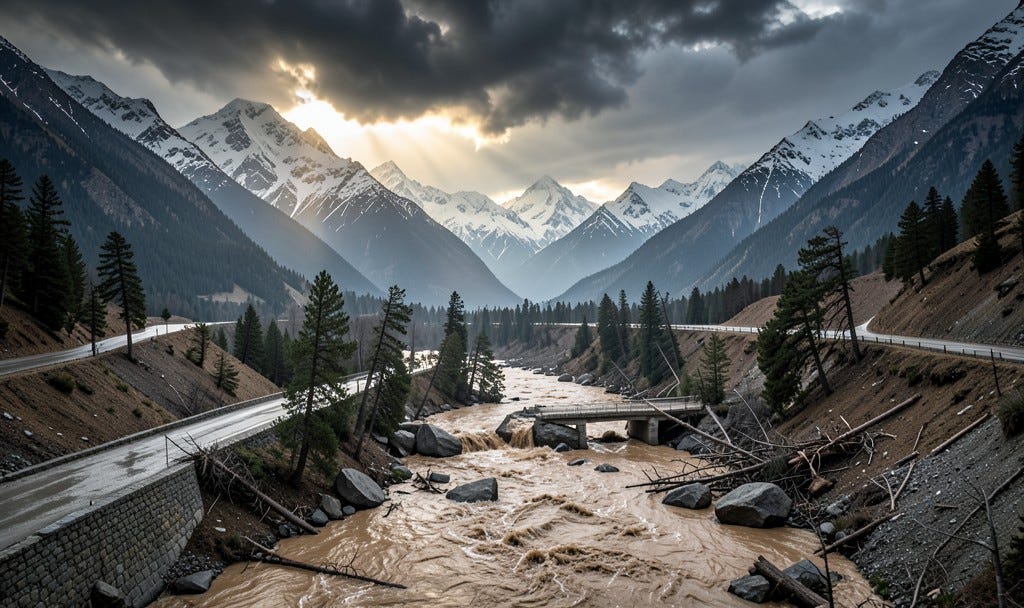
On August 26, 2026, a massive section of Himalayan glacial ice snapped away at 17,000 feet, plunging nearly 4,000 feet into Tibet’s Lhende River. The resulting avalanche of ice, rock, and mud dammed the river before violently breaching, sending a 30-foot surge down the Bhote Koshi and Trishuli corridors, sweeping away bridges, power stations, and hillside settlements across Nepal and Tibet.
The kinetic force was so immense that seismic systems initially misclassified the impact as a magnitude 4.4 earthquake before the USGS reclassified it as a magnitude 5.2 glacial collapse. Within twenty-four hours, authorities recovered over 270 bodies, while more than 1,300 people remained missing; though officials caution these are only initial estimates, and the true toll is feared to be significantly higher. Among the unaccounted for are local villagers, border personnel, and foreign pilgrims and travelers from around the globe
Watching the footage of entire communities swept away in minutes forces every believer to pause and wrestle with a difficult, perennial question: How are Christians called to view such staggering natural disasters, and where do we find our anchor and where to turn when even the mountains crumble beneath our feet?
The Mountains Are Not Eternal
Human beings instinctively perceive mountains as symbols of absolute permanence: unmoving, ancient, and indifferent to time. Yet Biblical revelation repeatedly reminds us that the created order is contingent, dependent, and fragile before its Sovereign Maker.
The prophet Nahum testified to this sovereign reality:
“The mountains quake before him; the hills melt; the earth heaves before him, the world and all who dwell in it.” (Nahum 1:5)
The prophet Micah echoed the exact same imagery:
“And the mountains will melt under him, and the valleys will split open, like wax before the fire, like waters poured down a steep place.” (Micah 1:4)
Similarly, the Psalmist declared of the Lord:
“who looks on the earth and it trembles, who touches the mountains and they smoke!” (Psalm 104:32)
These passages are not mere rhetorical flourishes; they teach us that even the grandest Himalayan peaks are finite structures. When mountain slopes give way, and rivers overflow, we are jarred awake from the illusion that the physical structures of this earth are self-sustaining or eternal.
Crucially, Scripture forbids us from treating catastrophic events as a simplistic scoreboard of divine retribution against specific victims. When discussing sudden tragedy, Jesus Himself brought up eighteen people crushed by the collapse of a tower to dismantle the self-righteous assumption that calamity corresponds directly to personal guilt:
“Or those eighteen on whom the tower in Siloam fell and killed them: do you think that they were worse offenders than all the others who lived in Jerusalem? No, I tell you; but unless you repent, you too will all likewise perish.” (Luke 13:4–5)
Christ firmly redirects the conversation away from cruel speculation and toward universal humility. Natural calamity is not a warrant to pass judgment on victims; it is an urgent reminder to every living soul that life in a fallen world is brief and uncertain.
A Groaning and Broken Creation
The apostle Paul provides the overarching theological framework for understanding natural decay in his epistle to the Romans:
“For the creation was subjected to futility, not willingly, but because of him who subjected it, in hope that the creation itself will be set free from its bondage to corruption and obtain the freedom of the glory of the children of God. For we know that the whole creation has been groaning together in the pains of childbirth until now.” (Romans 8:20–22)
A disintegrating glacier, an avalanche tearing through high alpine valleys, and a lethal debris surge flooding riverbanks are acute manifestations of creation’s present groan. The natural world does not operate in unhindered Edenic perfection; it remains entangled in the bondage of corruption brought on by the Fall.
Recognizing this reality protects the Christian conscience from two distinct spiritual errors. The first error is cynical fatalism, which dismisses widespread tragedy as empty, meaningless chance. The second error is harsh moralism, which falsely assumes the victims in Rasuwa or Gyirong were singled out for special punishment. Scripture presents a far more profound truth: all of creation is currently broken, groaning under decay, and longing for the day when Christ returns to restore all things.
Christlike Compassion for the Brokenhearted
Christian theology never permits detached intellectual reflection at the expense of genuine grief. Right now, thousands of families across Nepal, Tibet, and numerous other nations are enduring excruciating agony, waiting for news of missing children, parents, and friends. Relief workers and rescue teams continue to navigate treacherous, mud-covered terrain under the threat of secondary floods.
God does not call His people to observe this devastation with cold stoicism. The Scriptures command us:
“Weep with those who weep.” (Romans 12:15)
The Lord reveals Himself not as an unfeeling bystander, but as a caring refuge near to those who suffer:
“The Lord is near to the brokenhearted and saves the crushed in spirit.” (Psalm 34:18)
Psalm 46 gives voice to faith precisely when the physical earth appears to disintegrate beneath our feet:
“God is our refuge and strength, a very present help in trouble. Therefore we will not fear though the earth gives way, though the mountains be moved into the heart of the sea, though its waters roar and foam, though the mountains tremble at its swelling... The Lord of hosts is with us; the God of Jacob is our fortress.” (Psalm 46:1–3, 7)
Psalm 46 does not promise that mountains will never collapse or that waters will never rise. Rather, it assures us that God’s faithful presence remains unbreakable even when the mountains literally crumble into rushing waters.
Wisdom, Humility, and True Security
Tragedies of this magnitude expose the profound vulnerability of every earthly enterprise. Villages, hydroelectric installations, bridges, and trade corridors established over decades were wiped away in a matter of hours.
In the Sermon on the Mount, the Lord Jesus warned against placing our ultimate trust in temporal foundations:
“And the rain fell, and the floods came, and the winds blew and beat against that house, and it fell, and great was the fall of it.” (Matthew 7:27)
While builders and local inhabitants in mountain valleys act in good faith to sustain livelihood and community, the spiritual lesson remains vital for everyone: no earthly construct is indestructible. The apostle James cautions against human self-reliance with similar directness:
“Yet you do not know what tomorrow will bring. What is your life? For you are a mist that appears for a little time and then vanishes. Instead you ought to say, ‘If the Lord wills, we will live and do this or that.’” (James 4:14–15)
A flash flood that strikes without warning illustrates the wisdom of holding our temporal plans with reverence and humility before God.
Lament, Action, and Eternal Hope
In the wake of this disaster, the immediate duty of the church is threefold: persistent intercession for the missing and bereaved, practical generosity toward verified relief organizations operating in the Himalayas, and quiet solidarity with those who mourn.
Believers hold together two fundamental realities without compromise: our present world is broken and afflicted with deep sorrow, yet our ultimate hope rests in the God who will make all things new. The prophet Isaiah looked forward to that final redemption:
“He will swallow up death forever; and the Lord God will wipe away tears from all faces, and the reproach of his people he will take away from all the earth, for the Lord has spoken.” (Isaiah 25:8)
The apostle John confirmed this promise at the consummation of history:
“He will wipe away every tear from their eyes, and death shall be no more, neither shall there be mourning, nor crying, nor pain anymore, for the former things have passed away.” (Revelation 21:4)
Until that day breaks, we labor in mercy, extend open hands to the afflicted, and place our unshakeable hope in the Lord who remains our refuge even when the mountains fall.
~ Sunny
All Scripture quotations are from the Holy Bible, English Standard Version (ESV).
Sources & References
BBC News: Nepal Flash Floods: Hundreds Missing and Scores Dead After Glacial Collapse
The Independent: What Triggered Nepal Flash Floods: Glacier Collapse So Violent It Produced Magnitude 5.2 Seismic Signal
The New York Times: Deadly Nepal Flood May Have Been Caused by ‘Ice Avalanche’
CBC News: Death Toll Rises to 273, With More Than 1,300 Missing in Nepal and Tibet
Al Jazeera: Satellite Images Show Destruction From Nepal-Tibet Floods
Kathmandu Post: Flash Flood Hits Rasuwa, Damages Hydropower Projects and Infrastructure
NPR: Nearly 1,000 Missing in Nepal and Tibet After Glacial Collapse and Floods
Beautifully written. I love how the biblical verses explain the exact circumstances.